Ask a Buckhead homeowner when they last thought about a tree removal permit, and most will say never. Ask a listing agent the same question about a house that's about to go under contract, and the answer changes fast, because somewhere in a stack of old landscaping invoices or a contractor's receipt from a decade ago is the one document nobody thought to keep.
That gap, between what homeowners assume is a landscaping decision and what the City of Atlanta treats as a permitting event, just got more expensive to misjudge. Atlanta's rewritten Tree Protection Ordinance took effect January 1, 2026, with a technical correction filed February 2, 2026 (ordinance 26-O-1015), and it reaches further into Buckhead's mature-canopy streets than the headlines about developer costs suggested. The sharpest edge of this ordinance doesn't land on a construction site. It lands at the closing table, on sellers who didn't remove a single tree themselves.
What the New Fee Schedule Actually Costs
The city's recompense rate, the fee charged when a regulated tree comes down without an approved replacement plan, jumped from $30 per diameter inch to $140 per diameter inch, the first change to that number since 2001. Per-acre caps on R-1 and R-2 lots rose from $10,000 to $35,000. R-2A and R-3 lots, the zoning that covers a lot of Buckhead's smaller-footprint streets, saw their cap move from $7,500 to $25,000 per acre. Illegal removal, meaning no permit at all, now carries a fine that can reach $200,000 per acre, up from $100,000.
| Before | Since Jan. 1, 2026 | |
|---|---|---|
| Recompense rate | $30 per diameter inch | $140 per diameter inch |
| R-1 / R-2 cap | $10,000 per acre | $35,000 per acre |
| R-2A / R-3 cap | $7,500 per acre | $25,000 per acre |
| Illegal removal fine | up to $100,000 per acre | up to $200,000 per acre |
Those numbers explain why a homeowner planning a pool or an addition needs an arborist involved before a shovel goes in the ground. They don't explain why a homeowner who isn't renovating anything should care. That's the part most coverage of this ordinance skipped.
The Permit You Forgot You Needed, Ten Years Later
Georgia sellers disclose known material defects, and Atlanta's tree ordinance has no statute of limitations that forgives a permit nobody pulled. If a previous contractor took down a regulated tree five or ten years ago and never filed the paperwork, that gap doesn't disappear when the property changes hands. It surfaces later, sometimes during due diligence, sometimes when a buyer's attorney asks a routine question about landscaping work.
The fix is almost always simple. Pull whatever records exist on prior tree work, confirm a permit was actually filed at the time, and if something is missing, a certified arborist or an attorney experienced with the ordinance can usually resolve it before a home ever hits the market. What doesn't work well is discovering the gap after an offer is already in hand, when the conversation shifts from a paperwork fix to a negotiating point.
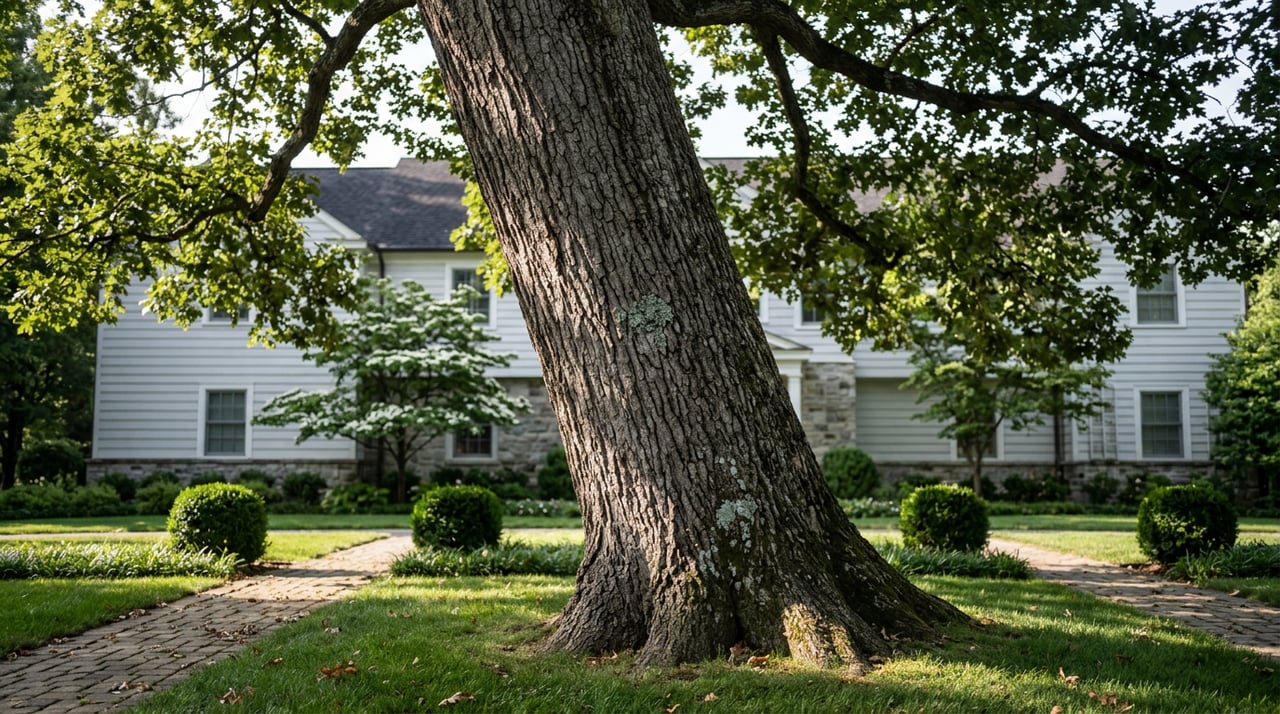
For a Buckhead seller sitting on a lot with a hundred-year-old white oak and three decades of landscaping history, that's not a hypothetical. It's a reason to have the records conversation with a listing agent before the sign goes in the yard, not after.
Two Layers of Review Before a Permit Even Applies
Buckhead's mature canopy sits inside the City of Atlanta, so every property answers first to the Tree Protection Ordinance and the City Arborist Division. But several of Buckhead's most established enclaves layer a second review on top of that, through active homeowners associations or civic design boards that expect sign-off before the city will even accept a permit application. That list includes:
- Tuxedo Park
- Brookwood Hills
- Paces
- Argonne Forest
Brookwood Hills carries an added wrinkle. It's both a National Register historic district and a City of Atlanta conservation district, which means exterior work and certain site changes go through conservation district review before permits move forward, even without a formal Certificate of Appropriateness requirement. Skip that local step, or find out about it only after submitting to the city, and the delay lands on whoever is trying to close a renovation or a sale on a timeline.
The city's own arborist gained more discretion under the rewrite too. One attorney who has watched the ordinance take shape, Craig Pendergrast, warned that removing numeric tree preservation standards from the final draft left the door open to inconsistent interpretation, calling it a setup for "litigation on all fronts." For a homeowner, that means a swimming pool or a relocated driveway might get steered toward an existing lawn area or patio at the arborist's discretion, regardless of the design a homeowner had in mind.
Permit First, Sell Second
For anyone holding a teardown-candidate lot in R-1, R-2, or R-3 Buckhead, the caps and fees above change the order of operations. Charlie Sears of Land Plus Associates, who has worked Buckhead's permitting process directly, put it simply when discussing pre-application steps: "Take advantage of the Pre-Application Conference with the City Arborist Department." That early meeting, outlined in the city's own ordinance under Section 158-51(f), gives a homeowner or seller a read on the arborist's likely position before a design is finalized rather than after.
The practical version of this advice, echoed by local reporting on the ordinance, is to permit an undeveloped or tear-down lot before listing it, not after. A buyer evaluating two otherwise identical Buckhead teardown lots will treat the one with an approved tree removal plan differently than the one where that cost and timeline are still unknown. The permitted lot has already answered the most expensive question a buyer would otherwise have to ask.
What This Means If You're Listing or Building This Fall
None of this makes Buckhead's canopy a liability. It's the opposite of that for most homeowners, since the ordinance still preserves a faster, narrower path for removing dead, diseased, or hazardous trees, separate from the redevelopment process, and the city has committed increased recompense revenue toward expanding arborist staff to address the review delays that have frustrated homeowners and contractors alike.
What it does mean is that the paperwork trail around a mature tree is now part of a property's transaction history, not a landscaping footnote. A seller who confirms that history early avoids a conversation that otherwise happens under time pressure. A buyer planning an addition or a pool budgets for recompense the way they'd budget for any other line item, instead of learning about it mid-permit. And anyone holding a lot in Tuxedo Park, Brookwood Hills, Paces, or Argonne Forest checks the neighborhood's own review process before assuming the city's permit is the only signature required.
A Few Questions Worth Asking Before You List
Does every tree removal in Buckhead require a city permit? Any regulated tree at or above the ordinance's diameter threshold generally requires review, though a separate, faster pathway exists for trees documented as dead, diseased, or hazardous.
Do HOA tree boards replace the city's process? No. In neighborhoods like Tuxedo Park, Brookwood Hills, Paces, and Argonne Forest, the association or civic review typically has to clear before the city will accept the permit application, not instead of it.
What if a past owner removed a tree without a permit? That gap doesn't expire with the sale. Pulling records early and resolving any missing paperwork before listing is far simpler than addressing it once a buyer's due diligence raises the question.
Buckhead's canopy is part of why these streets look the way they do, and part of why a house here holds its value the way it does. Understanding what the city and, in some neighborhoods, the HOA expect before a tree comes down is now part of understanding the property itself.
If you're weighing a renovation, a teardown lot, or a sale on a canopy-heavy Buckhead property, Stacy Shailendra can walk through what the current ordinance means for your specific address and timeline. Request Your Home Valuation to start that conversation.